C-DEP and AmCham jointly organized a second interactive roundtable of digital economy CEO's with Shri Nitin Gadkari, President of BJP at New Delhi on 5th June 2012.
Tuesday, 22 January 2013

Monday, 21 January 2013
National Seminar on Technological Sovereignty in ICT
National
Seminar on Technological Sovereignty in ICT
11th October 2012,
Ashoka Hall, Manekshaw Centre, New Delhi

LtR: Major General Dhruv C Katoch, Director, CLAWS, General Vikram Singh, Chief of Army Staff, Indian Army, Dr. Jaijit Bhattacharya, President, C-DEP, Lt. General S P Kochhar, Signals Officer in Chief, Indian Army.
Under the current procurement
norms, India has a policy for 30% offset on defence procurement. This creates
an immense opportunity for domestic manufacturers and service providers. More
importantly, this also creates an opportunity for developing domestic IPR to
take benefit of the 30% defence offset policy. However, in order to do so, it
is critical to identify the roadblocks that prevent domestic manufacturers from
tapping this enormous market. The first step in this process would be the
identification of institutional mechanisms to facilitate domestic
entrepreneurship.
In
order to initiate the process, the Indian Army accepted a proposal by Centre
for Digital Economy Policy Research (C-DEP) and Centre for Land Warfare Studies
(CLAWS), to organize a one day national level seminar on Technological
Sovereignty in ICT on 11th October 2012 at Manekshaw Centre, New Delhi. The
objective was to create a collaborative institution that will support and
enable the private sector to deliver indigenously developed technology to the
army.

Apart from the primary issue
of identifying the challenges of technological sovereignty, the discussions
covered various topics including the impact on modern warfare and on critical
information infrastructure, the strategic implications on supply chain and
trade and attempt to trace the road ahead.

During the inaugural session
of the conference, Lt. General S P Kochhar, Signals-in-Chief of the Indian
Army, mentioned that the Indian Army is upgrading various areas including ICTEC
(ICT, Electronics and Cyberwarfare). It is critical at this stage to understand
the concerns of stakeholders in delivering indigenously developed technology to
the army. It is also necessary to keep in mind the strategic implications as we
move towards net centric equipment. Thus it is imperative that India move
towards an ICTEC ecosystem profile which provides greater control over the
ICTEC layers to the military strategists.


Interactive Workshop on IPR
C-DEP, in partnership with the Department of Management Studies, IIT Delhi, organized a 'Workshop on IPR' on 17th December 2012 at DMS
Auditorium, 4th Floor, Vishwakarma Bhawan, IIT Delhi.
The workshop was planned as an informal discussion, Chaired by Mr. Tabrez Ahmad
from Microsoft. Intel’s Director for IP, Ms. Tina Chappell was present and participated in the
discussions along with participants from FICCI and AmCham.
The discussions covered the following:
A. National IP Strategy
B. Utility Model Patent
C. Long patent application pendency – time line being critical for IT industry.
D. Strategies to involve Indian managed companies in the fore front of discussion on IP
E. The forthcoming Trade Secret Law that India is getting ready to discuss and enact.
F. WIPO – TRIP+, IP standards
G. Capacity building to check IP violation
.jpg)
CEO's Roundtable on Digital Economy with Shri Nitin Gadkari, President, Bharatiya Janata Party

The Centre for Digital Economy Policy Research (C-DEP) and the Centre for Knowledge Sovereignty (CKS), in partnership with Amcham, NASSCOM, FICCI and ICA organized a CEO’s interaction on Digital Economy Policy with Shri Nitin Gadkari, National President, Bharatiya Janata Party, on 3rd May 2012 at the ITC Maratha, Mumbai.

With a cumulative
industry support worth $800 billion through participation from both domestic
and international multinationals, industry captains enriched the day’s deliberations,
and ensured that discussions revolving around the issues pertaining to the
IT/ITES, telecom and e-Governance sectors were highlighted successfully. This
was the first time that any such structured attempt had been made by top
industry captains to reach out to a national political party, and Shri Gadkari
was extremely pleased by the interaction.

During the keynote
address, Dr. Jaijit Bhattacharya, President, C-DEP, estimated the Indian
Digital Economy to be of USD 180 billion (Rs 540,000 cores), which pegged the
Digital Economy at over 20% of the Indian economy. He mentioned that the
Digital industry provided employment to over 20 million (2 crores) people and
led to many more jobs indirectly. This view was supported by Mr.Som Mittal,
President, NASSCOM, and Mr. Ajay Singha, Executive Director, AmCham.
Participants included
industry thought leaders like Ms. Debjani Ghosh, Managing Director, Intel South
Asia, Ms. Naina Lal Kidwai, President FICCI and Managing Director, HSBC India,
Ms. Kaku Nakhate, President, President and Country Head, Bank of America, Mr.
Sanjeev Gupta, President, Accenture India, Mr. S Ramakrishna, Chief Corporate
Offices, Nokia India, Mr. Arijit Sen, Lead Advisor, Global Government Policy,
Hewlett-Packard, Mr. Ravi Gupta, Managing Director, CSDMS, Mr. Pradeep Gupta,
Managing Director, Cybermedia, Prof. Rajanish Dass of IIM-A.

Addressing the gathering
of CEO’s, Shri Nitin Gadkari stated that private organizations need to make
fair and impartial recommendations for policy makers. He asked that these
recommendations should be made in simple language, understandable to all
stakeholders, and should be classified suitably into issues for a single MP,
for a specific ministry / department, for a specific state. Shri Gadkari
assured the industry that if the cases / recommendations were found worthwhile,
the follow up conversations with respective committees or state governments
would be organized.
Tuesday, 8 January 2013
Government, Industry and Academia Roundtable on Cybersecurity at IIT Delhi
Government, Industry and Academia convene Roundtable on Cybersecurity at IIT Delhi
Wed, Dec 19, New Delhi

Dignitaries from Government including National Security Council, Department of Telecommunications, CERT-IN, Industry and Academia participated in Roundtable on Cybersecurity and discussed the contribution of the Industry and the academia to the challenges in cyber-security faced by the nation and the capabilities that reside in India.
Mr. B. J. Srinath, CERT-IN, highlighted different perspectives of Cybersecurity that need to be addressed including Compliance, Enforcement, Data Security and Privacy, Critical infrastructure protection, Information Security, Legal and Strategic. He also highlighted the importance of managing Cybersecurity at Organizational level in Private sector and Government, Strategic importance at National level and collaboration at International level with other countries. He said that primary focus is required to leverage force multiplier effect by involvement of Private Sector and Academia to formulate mechanisms to achieve Cybersecurity initiatives of India.
Sh. Ram Narain, DDG, Department of Telecom, Government of India highlighted Cybersecurity challenges and Government strategy in 4 main areas of Telecom Network Security, Information and Data Security, National Security and Robustness/ Resilience in case of eventuality. He laid focus on guiding principles of Government policies ensuring Cybsersecurity are such that they help in building national capacities and whatever guidelines are formulated need to be cost effective citing that if the Security policy is highly costly, then it would be practically impossible to implement. He also mentioned the need for balance to the Security of Data and Information and assistance to Law Enforcement agencies for monitoring of Information exchange for National security. He specifically noted the need for systems to ensure traceability of a user through country wide allocation of IPv6 addresses. In the area of International Cooperation for ensuring Cybersecurity, he pointed out the need for level playing field for developing and developed countries and that instead of advising, countries should be communicating. With this approach, issues of cybersecurity could be solved in a much faster and much meaningful manner.
Brig. A Ghosh, National Security Council noted setting up of Joint Working Group under the chairpersonship of Ms Latha Reddy, Deputy National Security Advisor to work out the roadmap for engaging the private sector in a Public Private Partnership (PPP) for strengthening the cyber security architecture in the country. JWG includes representatives of both government and private sector. He said that the Institutional framework includes setting of a permanent JWG, with representatives of government and private sector, to coordinate and oversee the implementation of PPP on cyber security. He also mentioned that a Joint Committee on International Cooperation and Advocacy (JCICA) will advise JWG in promoting India’s national interests at various international fora on cyber security issues. He also mentioned that several Industry associations have been invited by the Government including FICCI, CII, TEMA, NASSCOM, DSCI, MAIT, COAI, IMI and AUSPI.
Art Gilliland, Senior Vice President - Enterprise Security, Hewlett Packard noted the recent trends of involvement of state and not-state actors No longer the threat of jamming critical infrastructure, but stealing information that is of interest to state/ non-state actors. He mentioned that Government, Industry and Academia in India are competing against a market that is advancing and specializing to outsmart the technologies and processes. He highlighted the importance of Government to formulate robust policies and Industry to build national capacities to ensure Cybersecurity for the country.
Dr. Kamlesh Bajaj, Chief Executive Officer, Data Security Council of India noted recent incidents have demonstrated that Cybersecurity is critical for national security. While the intelligence agencies have to master the use of cyberspace, cyberspace has no boundaries, even though nations are trying to police and control activities within their jurisdictions. Traditional dividing lines between defence and security, civilian and defence, military solutions and law enforcement, the public and private sectors, are breaking down. No single ministry can handle all facets of cyber security; there is a need for coordination. He mentioned that Lead agencies have to be appointed and empowered and involvement of private sector is essential because the networks and critical infrastructure are largely owned by the private sector. The government has to launch public-private partnership [PPP] programs to protect critical infrastructure. He specifically called for a cultural change in outlook.
Dr. M P Gupta, IIT Delhi noted the demand of 4.7 lakh cyber security professionals by 2015 for protection of IT infrastructure in the country as well as to serve the export market. He highlighted the need for Skill gap analysis & Manpower planning, Research in knowledge creation and cyber security experts and Capacity Building by involving academic institutions. He proposed formulation of policy for creating National Resource Centers that would evolve as think-tanks and undertake large research projects He also emphasized the use of pyramid model of increase the number of partner institutions and for establishment of Cybersecurity Center of Excellence at IIT Delhi.


SPEAKER PROFILES

Prof. (Dr.) Kanika T. Bhal
Professor & Head
Department of Management Studies
IIT Delhi
• Education - Sloan School of Management MIT & Indian Institute of Technology Kanpur
• 20 years of experience of work in IIT Delhi
• Professor - Indian Institute of Technology Delhi, Educational Institution; 1001-5000 employees; Higher Education industry 1993 – 2009 (16 years)
• Award name: Teaching Excellence Award
Description: Teaching Excellence Award to Prof. Kanika T. Bhal, Department of Management Studies for 2nd Semester 2010-11 for the Course Human Resources Management (SML731)
Sponsoring Organization: Indian Institute of Technology Delhi
• Area of Interest: Human Resource Management, Managerial Ethics, Leadership and Culture

Dr. Jaijit Bhattacharya
Adjunct Professor, IIT Delhi
President Centre for Digital Economy Policy Research
Director, Government Advisory, HP South Asia
Dr. Jaijit Bhattacharya is an e-Governance expert and is Director, Government Advisory, Hewlett Packard South Asia. Dr. Bhattacharya is also Adjunct Professor at IIT Delhi, and Vice President of Institute of Open Technology and Applications (IOTA), Government of West Bengal. He has been responsible for the creation of the next generation of solutions for governments, based on open standards.
Dr. Bhattacharya advises governments on e-governance strategies. He is an Advisor to the e-Governance Center of Excellence of Sri Lanka that is under the President’s office and has been conducting training for ADB institute in Tokyo on Public Expenditure Management and has helped World Bank develop curriculum for their e-Leadership program. He also delivers invited lectures at INSEAD Singapore campus, IIT Roorkee and at IIM Calcutta. Dr. Bhattacharya has developed business models and strategies for leading companies in the IT, media and computer hardware industries.
He has numerous research papers to his credit in leading journals and conferences. He is the co-author of the first book on e-Governance in India, ‘Government On-line – Opportunities and Challenges’, published by McGraw Hill and released by the Honorable President of India, Shri Abdul Kalam. He is also the author of the first book on Privacy Middleware in the world. Dr. Bhattacharya did his PhD from Department of Computer Science and Engineering IIT Delhi, MBA from Indian Institute of Management, Calcutta and B.Tech in Electrical Engineering from Indian Institute of Technology, Kanpur. He is also in the Board of Directors of FICCI and in the Executive Committee of MAIT, as well as the President of the Centre for Digital Economy Policy Research.

Mr Ram Narain
DDG (Security)
Department of Telecommunication
Government of India
Mr Ram Narain is an Indian Telecommunication Service (ITS) officer of 1979 batch and presently working as Deputy Director General (Security) DOT, Government of India. In this capacity he is responsible for formulation of telecom network security policies, enforcement of license terms and conditions and coordinating with security agencies on matters related to telecom security. In his 31 years career he has worked in the different functional areas of Telecom viz Network Security, Vigilance, R&D coordination, Planning, Operations & Maintenance, Administration, Project Management, Training, HRD & Career Development.
He possesses Degree in Electrical (Electronics) Engineering and Master in Business Administration (MBA). He is also a Fellow of Institute of Engineers (FIE), India and Fellow of Institute of Electroncis and Telecommuncation Engineers (FIETE), India. Besides, he is a prolific writer, who has written six books and several articles in the newspapers and magazines of repute. Twelve Management Skills for Success published in 2006 by Viva Books Pvt Ltd is his latest book.. He can be contacted on his email address ddgsecurity-dot@nic.in or ramnarain@hotmail.com. His mobile number is +9868132270.

Brig. (Retd.) Abhimanyu Ghosh
Brig (Retd) Abhimanyu Ghosh is a senior Telecommunication, Information Technology and Cyber Security professional. He was commissioned on 15 Jun 1975 and served in Corps of Signals, Indian Army for more than 35 years. He was the Chief Signals Officer of an operational zone and commanded Army Cyber Security Establishment for more than 3 years, among other prestigious appointments in Indian Army.
He is B Tech (telecommunication), Master of Science (M Sc), Master of Philosophy (M Phil) and has acquired Certifications in Cyber Security viz. Certified Information System Security Professional (CISSP), Certified Information System Auditor (CISA), Cyber Law etc. He is a Fellow of the Institution of Electronics and Telecommunication Engineers (IETE), New Delhi and a Life Member of Computer Society of India(CSI) and United Service Institution of India(USI).
Currently he is working with National Security Council Secretariat, New Delhi.

Dr. Kamlesh Bajaj
Chief Executive Officer
Data Security Council of India (DSCI)
Dr. Kamlesh Bajaj is the CEO of the Data Security Council of India (DSCI). He was the founding Director of the Indian Computer Emergency Response Team (CERT-In) at the Ministry of Communications and IT and served as Deputy Director General, National Informatics Centre (NIC). He was Deputy Controller of Certifying Authorities; and was the Global Head, Information Risk Management Practice, GCP, TCS.
At DSCI, Dr. Bajaj guided the development of best practices Frameworks for data security and privacy protection. He serves on various Government Committees on cyber security and ICT, and contributes to the activities of global bodies like OECD and EWI. He has published and lectured extensively on the IT Act 2000, cyber security and cyber crimes, e-commerce, emerging technologies, digital signatures, in national and international journals and conferences. Dr. Bajaj holds a Ph.D. (Physics) from McMaster University.

Art Gilliland
Senior Vice President
HP Software Enterprise Security Products
Hewlett-Packard Company
Art Gilliland serves as senior vice president of HP Software Enterprise Security Products (ESP). In this role, he leads efforts to maximize opportunities for selling security solutions and services across HP’s vast product portfolio and helps enterprise customers manage risk and compliance requirements.
A 15-year veteran of the enterprise security industry, Art joins HP from Symantec where he served as a senior vice president of the Information Security Group. While at Symantec, he held various leadership positions responsible for security solutions product engineering and management as well as strategy, planning, field enablement, industry relations and operations.
As part of the original IMlogic team, Art served as vice president of products and marketing and helped grow the company into an industry leader until it was acquired by Symantec. He also held key management, marketing and sales roles at Exchange Solutions, Inc., a partner loyalty program software provider, and was a senior consultant at Gemini Consulting, which specialized in innovation and technology strategies.
Art earned a Bachelor’s degree in Economics from Carleton College and a Master’s of Business Administration from the Harvard Business School. Recognized as an information security expert, he also holds several key patents in security and is a Certified Information Systems Security Professional (CISSP). He is based in Sunnyvale, California.

Dr. M.P. Gupta
Professor & Chair Information Systems & EGov
Department of Management Studies
Indian Institute of Technology Delhi
M.P. Gupta is Professor at the Department of Management Studies, Indian Institute of Technology Delhi (IIT Delhi), India. He is area Chair of Information Systems & also Coordinator-Center for Excellence in E-gov at IIT Delhi. He is known for his pioneering works in the area of e-governance that include 15 Doctoral thesis, 11 sponsored projects worth >5 crores, co-authored book “Government Online” and about 176 research papers that appeared in National and International Journals/Conference Proceedings.
Some of the reputed journals where his publications appear are ‘Government Information Quarterly (GIQ)’, ‘International Journal of E-government Research (IJEGR)’, ‘Electronic Government: An International Journal (EG)’ ‘International Journal of E-governance’, “Transforming Government: People, Process and Policy’, ‘Global Journal of Flexible Systems Management’ and ‘Vikalpa’. He is regular reviewer of these and many other International Journals (Omega, Decision Support Systems, DATA BASE for Advances in Information Systems).
He has steered several seminars and also founded the International Conference on E-governance (ICEG) in 2003 which is running into its 8th year. Under the umbrella of ICEG, more than 13 edited volumes have been released which are now available freely at www.iceg.net/2012. This is the largest collection of literature on the subject on e-gov.
He is involved in a number of policy making committees on ICT in the Centre and State Governments in India (CBI, DIT, NIC, CDSCO, IGNOU, MP and Jharkhand Govt); also regular member of UGC and AICTE expert committees. He is on the jury of prestigious award committees’ viz. Computer Society of India (CSI) Egov Awards, Web Ratna Awards (Government of India), Data Security Council of India (DSCI) Excellence Award and MP Government Awards for E-governance.
He is the recipient of the prestigious Humanities & Social Sciences (HSS) fellowship of Shastri Indo Canadian Institute, Calgary (Canada) and was a Visiting Fellow at the University of Manitoba. Also he was conferred Best Professor award in 2012 at Singapore by World Education Congress, CMO Asia with CMO Council as its Strategic Partner and Stars of the Industry Group as a research partner.
Contact: Phone:91-11-26591173, 9811027530 (M)
E-mail: mpgupta@dms.iitd.ernet.in
Friday, 28 December 2012
Launch of eHealth Centre (eHC)
News Release
Launch of Rapidly Deployable
fully integrated cloud-enabled eHealth
Centre
|
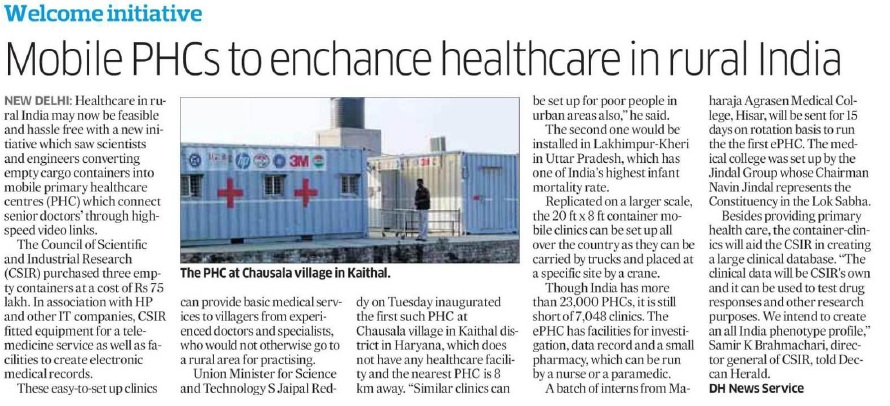

The eHealth Center is a fully integrated cloud enabled healthcare solution[DB3] that can be set up to provide affordable and preliminary
healthcare in remote areas that have no immediate access to primary healthcare.
The solution integrates medical instruments that collect basic patient health data,
with the Health Cloud, enabling medical diagnosis through remote medical
consultation, using videoconferencing.
The basic health care infrastructure in rural areas in
India is based on the population norms of having one Primary Healthcare Centre
(PHC) for every 30,000 people and one Sub-Centre for every 5000 people[1]. However,
the existing public health infrastructure is challenged by absence of tools for
remote management and monitoring. In addition, PHCs and other government medical
facilities face the problem of poor uptime of essential equipment. The existing
infrastructure also has a challenge of not being able to cover the last mile of
healthcare as there is lack of electricity and connectivity in remote parts of
the country.
A study conducted by the Indian Institute of Public
Opinion found
that 89 percent of rural Indian patients have to travel an average of 8
kilometres (5 miles) to access basic medical treatment and the rest have to
travel even further.
The eHC solution
addresses these challenges. It is a solution that is housed in a standard shipping
container which can be quickly transported to remote areas of the country by
rail, air or by land transport. It is affordable and easily deployable as
compared to brick and mortar alternatives and is equipped with basic cloud-integrated
diagnostic equipment, telemedicine studio, laboratory and a pharmacy. The eHC
is staffed by paramedics and nurses, with specialist medical interventions provided
through remote medical consultation. This minimizes the need for onsite skilled
doctors in isolated locations. Remote monitoring of the eHC functioning and its
equipment is done through the health cloud. 
The first shipping container has been deployed in Chausala village in Kaithal district, Haryana, in northern India. On arrival, it transformed into a sophisticated eHealth Center (eHC) with medical instruments to collect basic patient health data, and an IT infrastructure comprising IT equipment, an eHC Health Cloud, and an electronic medical records (EMR) solution with remote monitoring and consultation (videoconferencing facilities), and a health policy dashboard. Staff at the eHC can consult with senior doctors located at any larger medical center or hospital, enabling provision of accurate diagnoses and high-quality healthcare.
The eHC a Health Cloud platform is also to be used for conducting
scientific research and, maintaining centralized patient information. The Health Cloud will aid
in disease surveillance by tracking disease patterns and risk factors. It will
also provide efficient collection, storage and analysis of patient health data through
a centralized health database. The health profile of a the region as well as
monitoring of the daily use of the eHC is enabled by a Integrated eHC
Dashboard. The dashboard also provides analytics that will help health
policymakers.
The first eHC
solution deployed in Chausala has an average new patient registrations of 36 per day. Over 4000 patient visits in the first
100 days of operations.
Coverage in Press:
| India Coverage - Headlines Print Coverage | |||
| 1 | The Hindu Business Line | Research body, HP launch eHealth Centre | National |
| 2 | The Hindu | CSIR HP develop new system for better healthcare | Chennai |
| 3 | Deccan Herald | Mobile PHCs to enhance healthcare in rural India | National |
| 4 | Hindustan | Cannot force doctors to travel to remote areas (need technology to bridge the gap) | Delhi |
| 5 | Deshbandhu | CSIR and HP launch eHealth Centre | Delhi |
| 6 | National Duniya | CSIR and HP launch eHealth Centre | Delhi |
| 7 | Pratyaksha | Use of 'Cloud' to provide health facilities in remote areas | Delhi |
| 8 | Jansatta | Reddy launched the eHealth Centre | Delhi |
| 9 | Punjab Kesari | eHC will fulfill the dream of providing health services to the common man | Delhi |
| 10 | Virat Vaibhav | Affordable medical facilities in Sudoor village through eHealth Centre | Delhi |
    |
|
Tuesday, 18 December 2012
Setting up of Centre for Digital Economy Policy Research
Centre for Digital Economy Policy Research, a leading think tank in Digital Economy, was setup with the following objectives
i.
To
bring together the finest brains in Academia, Industry and civil society to formulate
proposed policies on Digital Economy that will help in economic growth and prosperity of India.
ii.
To
focus on promotion of the Indian Digital Economy and creation of a larger
manufacturing and services ecosystem, based on non-discriminatory policies.
iii.
To
provide support to the Governments in India, at the central , state and local
level and their various agencies, to make India a global digital Industry hub and
to enhance the ICT security profile of the country and its institutions.
iv.
To
provide support to governments and other agencies outside of India in issue
related to digital economy.
v.
To
collaborate with domestic and international counterparts and Industry
Associations to position the Indian digital industry as globally competitive.
Subscribe to:
Comments (Atom)